The AI follow-up system: stop losing jobs to quotes you forgot to chase
By Tijo Gaucher & Annaki Nguyen · Human+AI
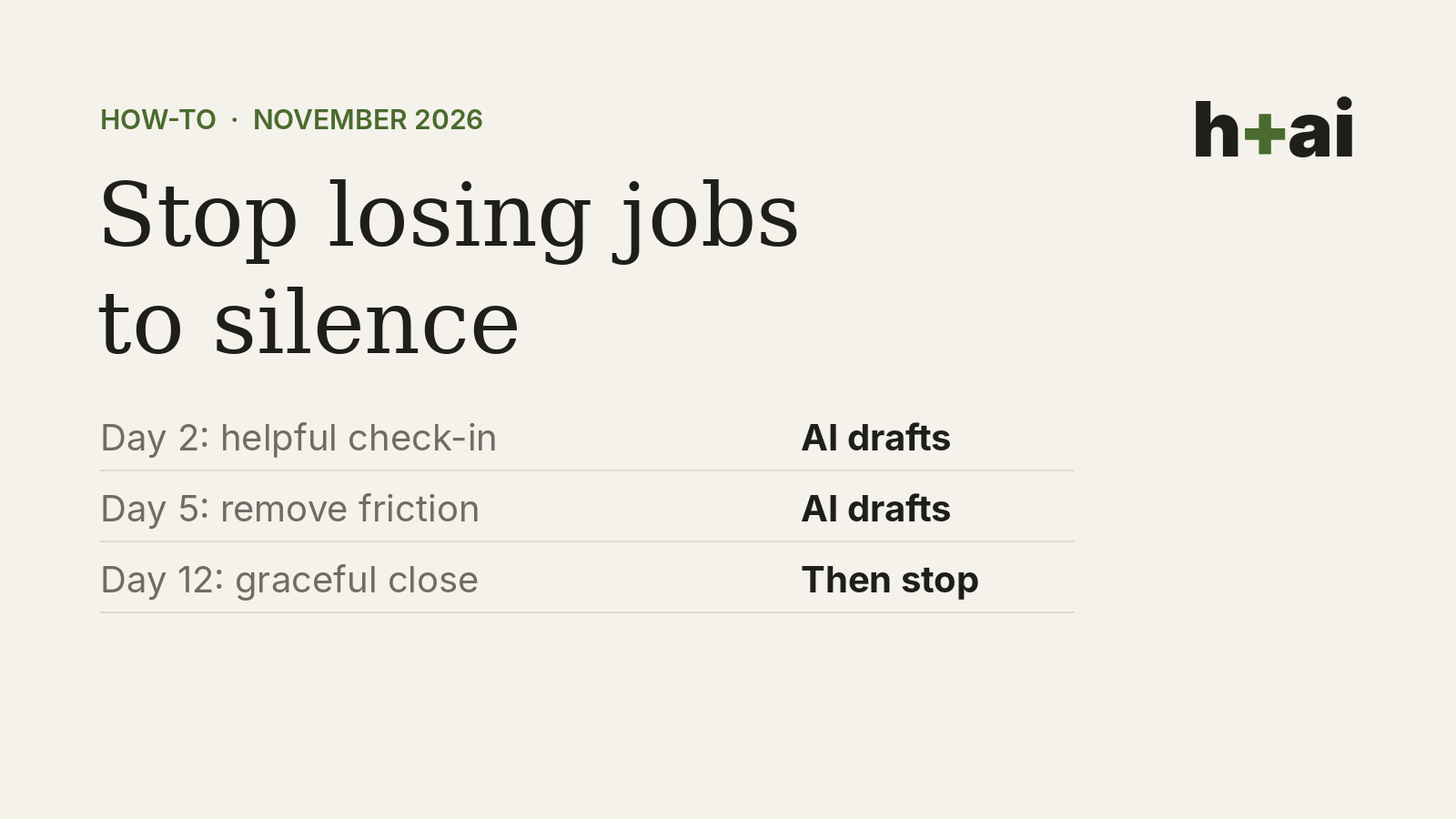
Short answer: check what your quoting tool already does first. Jobber, ServiceM8, Tradify and Housecall Pro can all send timed reminders. Then, if you want follow-ups that mention the actual job and wait for your approval, add an AI step that drafts them from the quote and your notes, with stop rules so nobody gets chased after they've replied, booked or said no.
Why quotes die in silence
Most lost quotes aren't rejected. They just go quiet, because the customer got busy and nobody followed up. The famous "reply within an hour" research is real but old: a 2011 Harvard Business Review study of online sales leads found most companies responded far too slowly (HBR, 2011). It measured first replies to new leads, not chasing a quote you've already sent.
For trades today, Jobber's survey of 1,050 US home service owners found only 20% reply to new leads within an hour, while over 55% of customers expect a reply that fast (Jobber, Dec 2025). There's no good public study on how many follow-ups win the most jobs. Anyone quoting an exact number is guessing.
First, check what your quoting tool already does
| Tool | Built-in quote follow-up | Plan |
|---|---|---|
| Jobber | Up to 2 reminders, up to 90 days after sending, by email or text | Connect, Grow, Plus |
| ServiceM8 | Up to 5 steps; stops on reply, acceptance or status change | Automation add-on |
| Tradify | Reminders at 7 and 14 days and 3 days before expiry | Pro and Plus |
| Housecall Pro | Pipeline: up to 3 follow-ups by status, then auto-decline | Check your plan |
| ServiceTitan | An AI agent texts about unsold estimates and can book the job | Enterprise add-on |
| QuickBooks Online | None for estimates (invoice reminders only) | Needs a workaround |
| Xero | None yet; requested by 545 users and accepted, no date | Needs a workaround |
Checked 27 November 2026 on each vendor's help pages.
Where built-in reminders fall short
They resend the same message on a timer. None of the help pages we read describe the reminder mentioning what you talked about on site, offering a smaller option, or waiting for you to check it. That's the gap an AI step fills.
The AI follow-up system
- Trigger: a quote has been sent and there's no reply after a set number of days. The trigger comes from your quoting tool, your CRM or a simple sheet of open quotes.
- Context: the workflow pulls the quote's line items, your site-visit notes and the last email in the thread.
- Draft: AI writes a short follow-up in your voice that mentions the actual job, and saves it as a draft reply in the same email thread.
- Approve: you read it and press send. Or approve a template once and let it send with only safe details filled in.
- Close out: after the last step, the quote is marked lost, with the reason if you know it.
Build it with the free n8n course, pull quote details with the CRM course, and detect replies with an inbox that sorts itself.
Stop rules that keep you from being annoying
Before every follow-up, the workflow checks, and stops if:
- the customer replied, about anything
- the quote was accepted, the job booked or paid
- they said no, or went with someone else
- they asked to stop, or replied STOP to a text
- the quote expired, or three follow-ups have already gone
A follow-up sequence that doesn't nag
| When | Purpose | Example |
|---|---|---|
| Day 2 | Helpful check-in | "Any questions on the deck quote? Happy to walk you through the options." |
| Day 5 | Remove friction | A detail from the visit, a smaller option, or an available start date |
| Day 12 | Graceful close | "Should I close this out, or keep the March slot open for you?" |
This is our suggested pattern, not a statistic. It sits within what the big quoting tools recommend: Jobber suggests a first follow-up two to three days after the quote and moving on after about three (Jobber). Keep each one short, mention the actual job, ask one clear question, make "no" easy to say, and never invent urgency.
Staying on the right side of the law
Not legal advice, but the basics, from official sources:
- US email (CAN-SPAM). A follow-up chasing a quote that hasn't been accepted is most likely commercial email. Include your postal address and a clear way to opt out, and honour opt-outs within 10 business days. Penalties run up to $53,088 per email (FTC).
- UK email (PECR). The ICO counts requesting a quote as negotiations for a sale, so the "soft opt-in" can cover follow-ups to individuals, as long as you offered an opt-out when you collected their details and in every message since (ICO).
- US texts. Customers can opt out by replying STOP or any reasonable way, and you must honour it. Business texting from an app usually requires carrier registration, known as A2P 10DLC (Twilio). Rules here are still changing, so check before you turn on automated texts.
Simple rule: an opt-out line in every automated follow-up, stop at the first "no" or STOP, and keep a list of who opted out.
Next: speed up the quote itself with AI-drafted quotes, or see where follow-ups rank in the first AI workflow to build.
Questions people ask
How many times should I follow up on a quote?
No solid study gives a number for trades. Guidance from the big quoting tools settles on two or three follow-ups over one to two weeks, then close the quote. Stop immediately on any reply or a no.
Can AI send follow-ups without me checking them?
It can, if you approve a template once and the AI only fills in safe details like the customer's name and the job. Start with drafts you approve, and only move to automatic sending once you trust what it writes.
Do QuickBooks or Xero follow up on quotes automatically?
Not natively as of November 2026. QuickBooks reminders cover invoices, and Xero's quote reminder request is accepted but not yet built. Use an n8n or Zapier workflow that watches for estimates still pending.
Is a quote follow-up email marketing under the law?
In the US it's usually treated as commercial email under CAN-SPAM, so include your postal address and a way to opt out. In the UK a quote request can count as negotiations for a sale, so the soft opt-in can apply if every message offers an opt-out. This isn't legal advice.
Want every quote chased, politely, without you remembering?
We set it up on your own email and quoting tool at a fixed price: follow-ups drafted from the job, stop rules built in, nothing sent without your say-so. Free 20-minute call to start.