AI agent benchmarks 2026: every major leaderboard, explained
By Tijo Gaucher & Annaki Nguyen · Human+AI
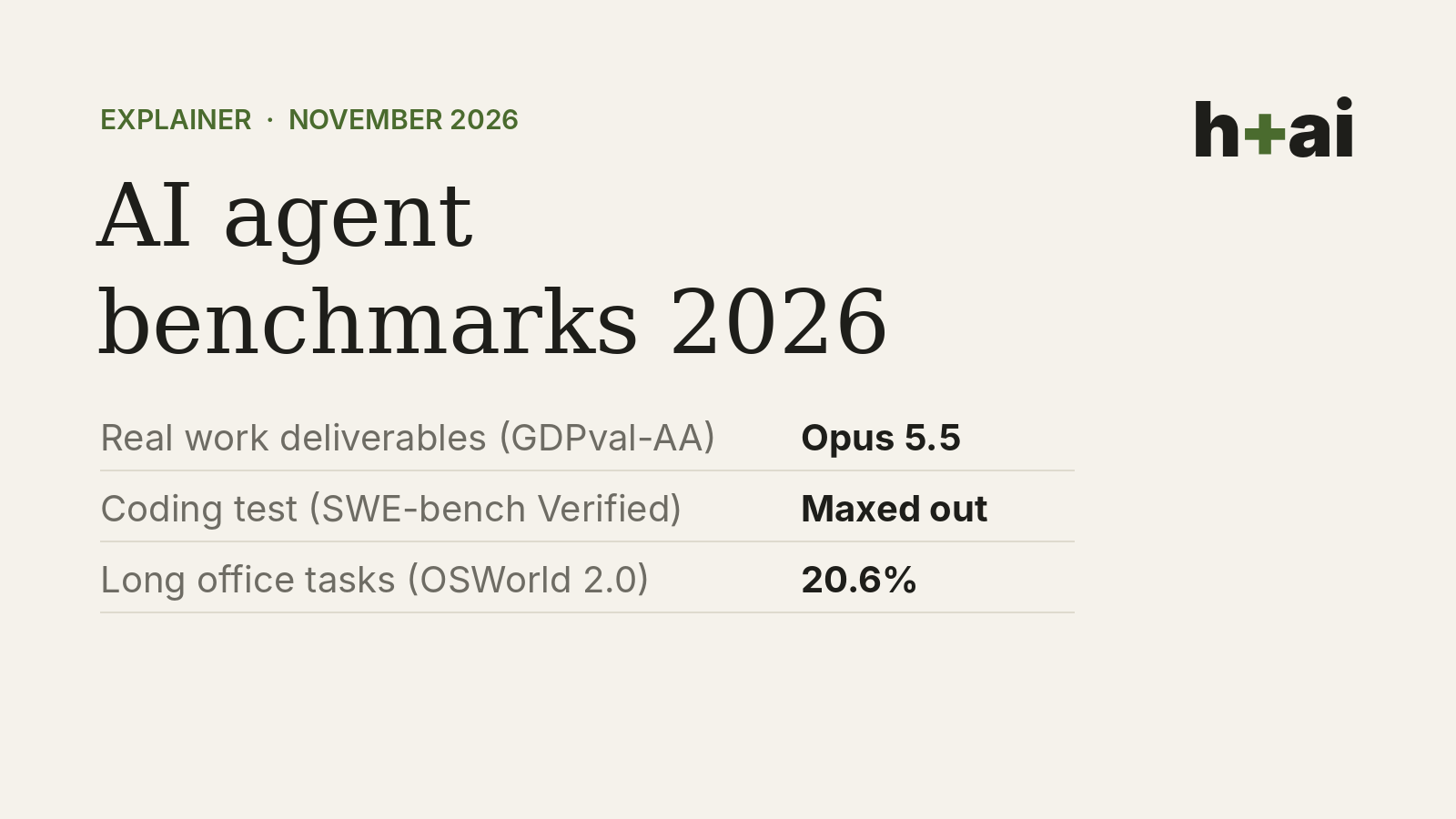
Short answer (checked 27 November 2026): Claude Opus 5.5 leads the test that looks most like everyday business work (GDPval-AA). Claude models tie for top spot on Vals' independent Terminal-Bench run, while GitHub Copilot's agent tops the official board. The famous coding test, SWE-bench Verified, is maxed out. And the hardest realistic test, long office workflows in OSWorld 2.0, is still only about one in five fully completed. Agents are impressive on short tasks and unreliable on long ones.
The leaderboard, in one table
| Benchmark | What it tests | Closest business task | Leader and score | Measured by | Status |
|---|---|---|---|---|---|
| GDPval-AA | Produces real work (reports, slides, spreadsheets) across 44 occupations, judged blind | Office and admin work | Claude Opus 5.5 (Max): Elo 1866 | Artificial Analysis (independent) | Live |
| Terminal-Bench 4.1 | Hard jobs at the command line | IT and technical ops | GitHub Copilot (Copilot Fusion): 71.2% | Official board, agent + model | Live |
| Terminal-Bench 4 (Vals) | Same tasks, every model in one standard setup | IT and technical ops | Claude Fable 5.2 and Opus 5.5, tied: 65.15% | Vals (independent) | Live |
| OSWorld 2.0 | 108 long desktop workflows, about 1.6 hours each for a person | Multi-app admin | Claude Opus 4.8: 20.6% fully completed | XLang (paper) | Live, hard |
| SWE-bench Pro | Harder real coding fixes | Software | Muse Spark 1.1: 61.5% on Scale's run | Scale AI | Live, contested |
| SWE-bench Verified | 500 checked Python bug fixes | Software | Claude Opus 5: 97.0% | Vals (independent) | Saturated, archived |
Each leader was checked on its live leaderboard on 27 November 2026. Scores change monthly, and the same model can score differently depending on the setup around it, so compare like with like.
What an AI agent benchmark actually is
A benchmark is a driving test: a fixed set of tasks, scored the same way for everyone. It tells you who passed the test, not how well they'll handle your commute. An "agent" benchmark goes further than a quiz. The AI has to take steps, use tools like a browser or a terminal, and finish a job.
The benchmarks that look most like your business
- Reports, decks and spreadsheets: GDPval-AA. 220 tasks from 44 occupations. Models work with a shell and a browser, and a judge compares their deliverables blind (Artificial Analysis). If you want an AI to produce work, this is the one to watch.
- Long admin workflows: OSWorld 2.0. Realistic desktop jobs that take a person about 1.6 hours. The best model fully finished 20.6% of them (OSWorld 2.0). That's the honest picture for "let the AI run my back office".
- Customer service: tau-bench. Tests whether a support agent follows your policies while talking to a customer and using tools, and reports whether it succeeds every time across repeated tries, not just once (tau-bench). Consistency is what matters with customers.
- IT and technical work: Terminal-Bench. Hard command-line jobs with generous time limits (Terminal-Bench).
Why most headline scores need an asterisk
- Maxed-out tests. On SWE-bench Verified the top three models all score above 96%, and Vals has stopped running it on new models because it's saturated (Vals).
- Flawed and leaked tests. OpenAI stopped reporting SWE-bench Verified in February 2026. In an audit of problems its model kept failing, 59.4% had flawed tests or descriptions, and frontier models could reproduce the original answers from memory (OpenAI).
- Exploitable tests. UC Berkeley researchers audited 13 agent benchmarks and rated all of them critical risk, with 45 working exploits. On WebArena, the answers sat in a readable config file (Berkeley RDI).
- Self-reported numbers. Launch posts quote the lab's own runs. On SWE-bench Pro, Scale AI's own top score is 61.5% (Scale), well below figures you'll see in launch announcements. Ask who measured it.
How long can an AI agent work on its own?
METR measures how long a task, in expert-human time, an AI can finish half the time. Its best-known example: GPT-5 handled tasks of roughly 2 hours 17 minutes. METR has since stopped updating the page and says its tasks can't reliably measure beyond 16 hours (METR). Translation: newer models outgrew the ruler, but mostly on software tasks, not your inbox.
The model vs the setup around it
The same model scores differently depending on the tools, prompts and retries wrapped around it. Terminal-Bench shows it plainly: Claude Opus 5.5 scores 65.8% inside Claude Code on the official board and 65.15% in Vals' plain setup, while GitHub Copilot's own agent system tops the board at 71.2% (Terminal-Bench, Vals). When you compare products, you're comparing the model and the setup together.
What this means for picking an AI tool
- Match the benchmark to the job. GDPval for documents, tau-bench for support, OSWorld 2.0 for admin. Ignore the rest.
- Trust independent runs (Vals, Artificial Analysis, Scale, METR) over launch-day numbers.
- Above 90%, scores stop separating models. Look at the hard, live tests instead.
- Reliability beats a best-ever score. Ask whether it gets the task right every time.
- Cost per task counts. On Vals' Terminal-Bench run, the top models cost about $10 to $15 per task (Vals). Cheaper models can be close enough.
- Run your own 10-task test. Ten real tasks from your week, three runs each. It beats any leaderboard for your decision.
Older benchmarks: AgentBench, GAIA and WebArena
AgentBench (Tsinghua) tests eight mixed environments, from a Linux shell and SQL to online shopping and a card game. It shaped early agent research but has few recent frontier entries (GitHub). GAIA asks assistant-style questions at three difficulty levels that need search, files and several steps; top entries are now close to its ceiling, and Princeton's HAL board for it has paused updates (HAL). WebArena runs tasks on copies of shopping, forum and code sites, and is the one Berkeley found could be gamed by reading the answers file. All three are worth knowing; none should decide what you buy.
Related: A2A vs MCP explained and what AI automation costs a small business.
Questions people ask
What is the best AI agent in 2026?
It depends on the job. As of late November 2026, Claude Opus 5.5 leads Artificial Analysis' GDPval-AA test of real work deliverables, Claude Fable 5.2 and Opus 5.5 tie on Vals' Terminal-Bench run, and GitHub Copilot's agent tops the official Terminal-Bench board. Test the tools on your own work before choosing.
Are AI agent benchmarks trustworthy?
Partly. UC Berkeley researchers audited 13 agent benchmarks in April 2026 and rated every one critical risk, with 45 working exploits. OpenAI stopped reporting SWE-bench Verified over flawed tests and leaked answers. Prefer recent, independent leaderboards over launch-day claims.
Is SWE-bench still useful?
SWE-bench Verified isn't: top models score around 97% and Vals no longer runs it. SWE-bench Pro is harder, but lab-reported scores run far above Scale AI's own runs, so check who measured the number.
What happened to AgentBench and GAIA?
Both still exist, but they've faded as frontier yardsticks. AgentBench has few recent frontier entries, and GAIA's top scores are close to its ceiling. Most comparisons now use Terminal-Bench, tau-bench, OSWorld and GDPval.
Want to know which AI actually handles your work?
Benchmarks test someone else's tasks. On a free 20-minute call we'll pick 2 or 3 jobs from your week and tell you which tools are worth testing on them.