Is auto-blogging safe in 2026?
By Tijo Gaucher & Annaki Nguyen · Human+AI
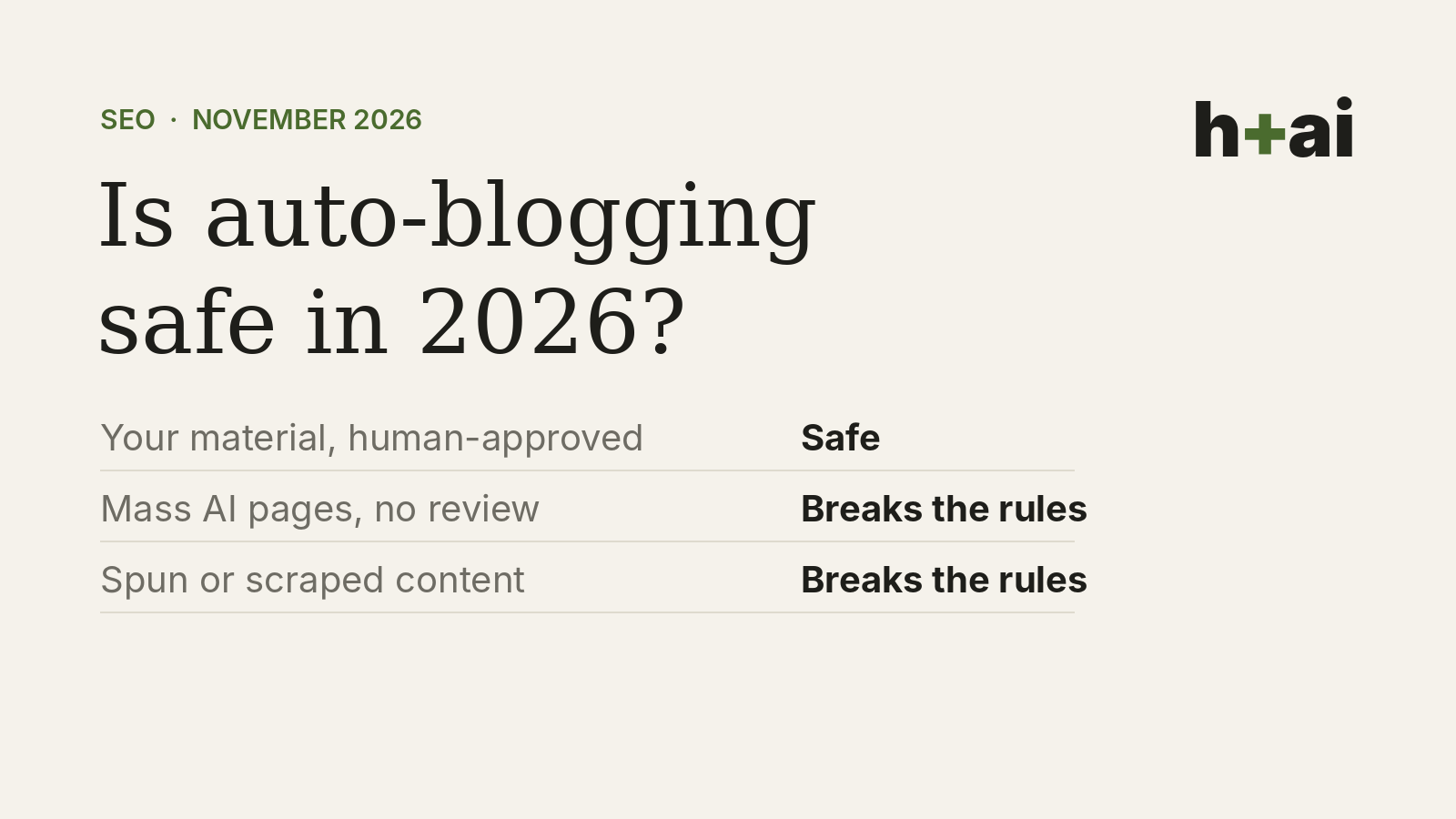
Short answer: using AI to write isn't the risk. Publishing lots of pages that add nothing, with no human checking them, is. That's what Google's "scaled content abuse" policy describes, and it applies whether a person, a tool or a Fiverr gig made the pages. Since May 2026 the same rules cover AI Overviews and AI Mode. Google ran four spam updates in 2026. A self-updating site is safe when it publishes drafts from your own material, a person approves each one, and you post at a human pace.
We build self-updating websites for small businesses, and this site runs on one, so we have a stake in the answer. That's why everything below links to Google's own documentation or to the study behind it.
What Google actually says
- AI content is allowed. Google's position since 2023 is that it rewards quality however it's produced, and that AI gives content no special boost: "It's just content." (Google, 2023)
- Mass-producing pages to rank isn't. The scaled content abuse policy covers many pages made mainly to manipulate rankings, "no matter how it's created". Its examples include AI pages that add no value, scraped or "synonymized" feeds, and stitching other sites' content together (Spam policies).
- The rules now cover AI answers. On May 15, 2026 Google clarified that its spam policies also apply to generative AI responses in Search (Search Central changelog). Gaming AI Overviews with junk pages is the same violation as gaming the blue links.
- A human has to check it. Google's guide to using generative AI on your site says to fact-check and review all AI-generated content, including titles, descriptions and image alt text (Google).
- Spam reports can now trigger penalties. Since April 2026, Google may use spam reports from the public to take manual action (changelog). A competitor can flag you.
Google's 2026 updates so far
From Google's Search Status Dashboard. Google doesn't say which tactics each spam update targeted.
| Update | Started | Finished (about) |
|---|---|---|
| March 2026 spam update | Mar 24 | Mar 25 |
| March 2026 core update | Mar 27 | Apr 8 |
| May 2026 core update | May 21 | Jun 2 |
| June 2026 spam update | Jun 24 | Jun 26 |
| August 2026 spam update | Aug 18 | Aug 21 |
| September 2026 spam update | Sep 24 | Oct 7 |
| November 2026 core update | Nov 10 | Nov 24 |
| December 2026 core update | Announced Nov 24 | Not yet |
Source: Google Search Status Dashboard, checked 26 November 2026. Finish dates are worked out from the durations Google lists.
What happened to sites that tried it
- March 2024: when Google launched the scaled content policy, one tracker of about 49,000 ad-funded sites found 837 removed from Google entirely. Together they'd had more than 20 million monthly visits (Search Engine Journal).
- 2026, the knock-on effect: a news site with more than 850,000 AI-generated local pages got a manual action for scaled content abuse. That section dropped out of Google, and it lost most of its ChatGPT citations too (GSQi). A Google penalty can now cost you AI answers as well.
- The August 2026 spam update: case studies include sites with hundreds of thousands of programmatic, almost entirely AI-written pages losing rankings across the board (GSQi).
- The pattern over time: SEO consultant Lily Ray reported that of 220+ sites she monitored using scaled AI content, more than half lost at least 30% of their peak traffic (Lily Ray). It works until it doesn't.
And the other side: Ahrefs looked at 600,000 top-ranking pages and found most contain some AI-written text, with effectively no link between how much AI a page used and where it ranked (Ahrefs). The sites that got hit weren't punished for using AI. They were punished for scale with nothing behind it.
What the autopilot offers promise
Taken from their own pages on 26 November 2026. We're describing the offers, not accusing anyone who buys them.
| Type of offer | What it promises | The risk |
|---|---|---|
| AI blog tools with an autopilot mode | Posts on a daily or weekly schedule, with a choice of auto-publish or drafts | Low if you choose drafts and review them. RightBlogger's own page says automation doesn't protect you from penalties. |
| Free n8n auto-blogging templates | Topics in, posts published straight to WordPress, no review step | High: nothing stops a wrong or empty post going live |
| "500 AI articles" Fiverr gigs | Hundreds of posts on autopilot, some 'automatically spun' from other sites | Very high: spinning and scraping are named in Google's policy |
| "Index 10x faster" and auto-backlink add-ons | Faster indexing and links without outreach | Google's Indexing API is only for job and livestream pages, and bought links break the link spam rules |
Sources: RightBlogger, n8n template, Google Indexing API, Google spam policies.
Warning signs an offer will get you in trouble
- "Publishes directly" or "100% automated", with no draft or approval step.
- The selling point is volume: hundreds of posts a month.
- Content "fetched" from other sites or RSS feeds and rewritten.
- Promises of rankings, AI Overview spots or instant indexing. Google says no outside tool has access to its ranking systems (Google).
- Invented author names or AI-generated headshots.
- Hundreds of near-identical pages, one per city or one per phrasing of a question.
- Someone else's content placed on your domain to borrow its reputation. Google's site reputation policy names white-label services specifically.
A safe way to run a self-updating site: 10 steps
This is the process we use on humanai.news and build for clients.
- 1
Start from something only you have.
A voice note, a video, a customer question you answered today. Google's 2026 guide on AI search asks for first-hand, non-commodity content, not another generic tips list.
- 2
Save every post as a draft.
Nothing goes live without a named person reading it. Google says to fact-check and review all AI-generated content, because models predict likely words rather than look up facts.
- 3
Check every number and link.
If a stat has no source you can click, cut it.
- 4
Publish on a pace you can keep.
Weekly is plenty. Frequency isn't a ranking signal, but a flood of posts on unrelated topics is one of Google's listed warning signs.
- 5
Put a real name on it.
A real byline linked to a real bio. Google treats invented authors and AI headshots as deception.
- 6
Say how AI helped, where readers would wonder.
A one-line note is enough: written from Tijo's voice note, edited by Annaki.
- 7
Embed the source video and use your own images.
Google's AI guide recommends good images and video, and video markup helps it understand the page.
- 8
Never spin, scrape or mass-produce variations.
No rewritten competitor articles, no 50 near-identical city pages, no pages made just to catch every phrasing of a question.
- 9
Prune instead of padding.
Noindex or delete thin pages, and don't change dates to look fresh without real updates.
- 10
Check Search Console every week.
Manual actions, the Pages report and Performance. If a spam update rolls out, look at the week after it finished.
Sources: Google's AI search guide, helpful content guidance, Google on publishing frequency, noindex, Manual Actions report.
What to check in Search Console
- Manual actions: should say "No issues detected". If it doesn't, fix the problem, then request a review explaining what you removed and changed. Reviews can take days or weeks.
- Pages: watch whether your important posts are indexed. "Crawled, currently not indexed" on a few thin pages is normal. On your best pages it's a sign to improve them.
- Performance: clicks and impressions per post. Since 2025 this includes AI Mode traffic.
The short version for owners
If a tool or freelancer offers to fill your blog for you, ask three questions: where does the material come from, who approves each post before it goes live, and how many posts a month? Good answers are your own voice notes or videos, you, and a handful. Anything else is a bet that this year's spam updates miss you.
Want to build it yourself? Our free course A website that updates itself walks through it step by step for WordPress, Webflow and Shopify. If you use an AI agent, the matching free skill runs the same process.
Questions people ask
Will AI-written blog posts hurt my SEO?
Not because they're AI-written. Google says it rewards quality however content is produced, and large studies find no meaningful link between AI use and rankings. What gets sites hit is publishing many pages that add nothing, especially with no human review. That breaks Google's scaled content abuse policy whoever or whatever wrote them.
Is auto-blogging against Google's rules?
Automation itself isn't. Auto-publishing lots of AI pages with no added value is exactly what the scaled content abuse policy describes. Spinning, scraping feeds and rewriting other sites' articles are named in the policy as examples.
How often should a small business blog?
As often as you have something real to say. Google has said publishing frequency alone isn't spam and that volume doesn't buy better crawling. Weekly is a good, sustainable pace for most owner-run businesses.
Do Google's spam rules apply to AI Overviews?
Yes. On May 15, 2026 Google clarified that its spam policies also apply to generative AI responses in Search, which covers AI Overviews and AI Mode.
Want a site that updates itself, safely?
We set it up in your own accounts: your voice notes or videos become drafts, you approve each one, and it publishes. Fixed price, live in 2 to 4 weeks. Start with a free 20-minute call.
Book a free 20-min call