Hire an AI automation agency or do it yourself?
By Tijo Gaucher & Annaki Nguyen · Human+AI
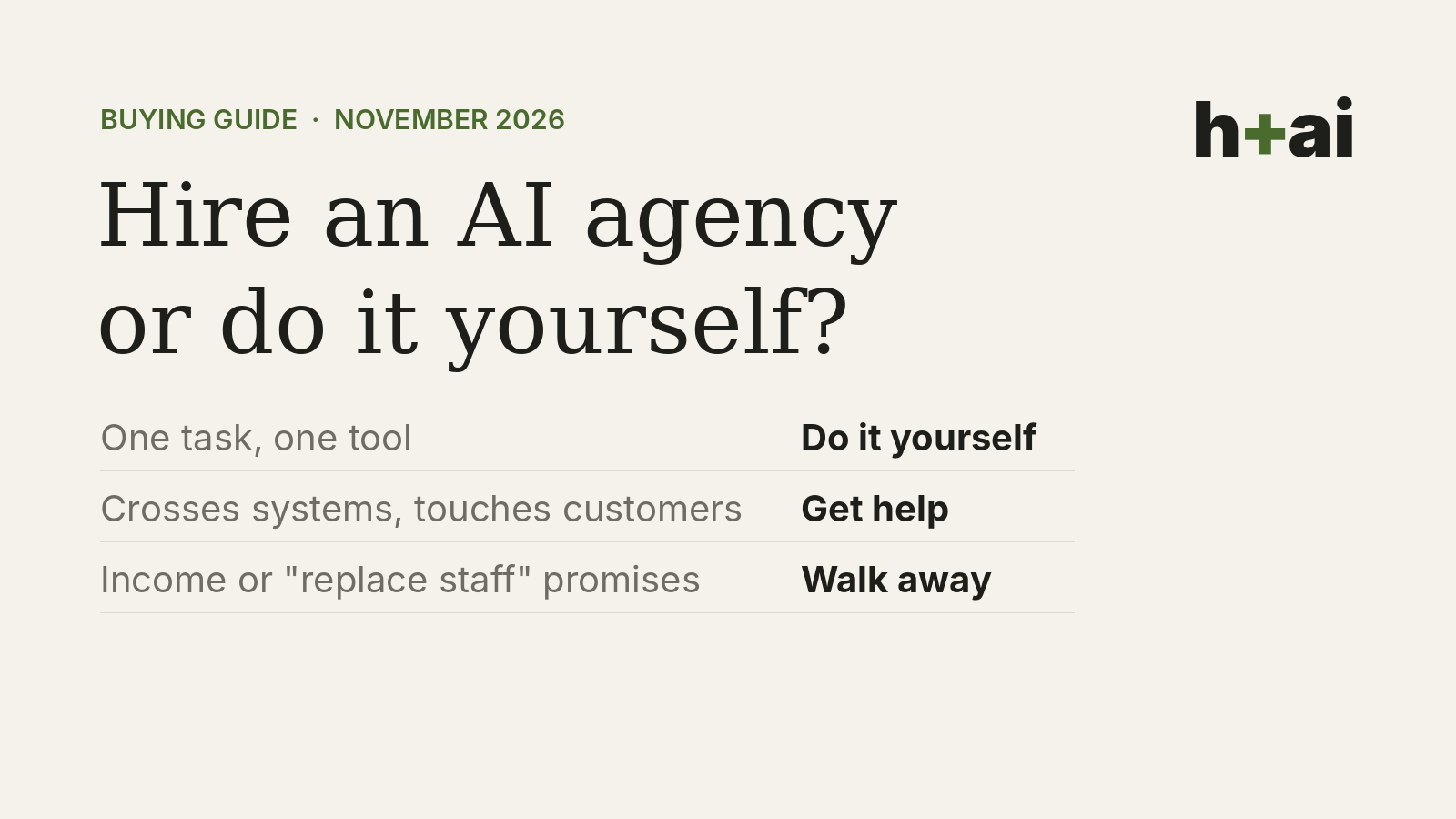
Short answer: do it yourself if the job is one repeated task inside one tool, like drafting emails or posts. Get help when it crosses two or more systems, touches customers or money, or nobody has the hours to keep it running. And walk away from anyone promising income, "passive" results or to replace your staff. The checklist below sorts the rest.
We sell AI builds, so we have a bias. We've tried to correct for it the same way we did in our cost guide: every outside claim links to its source, and we say plainly when doing it yourself is the better call. Often it is.
Why your inbox is full of AI agency pitches
Starting an "AI automation agency" is itself a popular online course. The largest free community teaching it on Skool had about 336,000 members when we checked in November 2026 (Skool). Another paid program promises members their first client within 90 days (review). Those courses teach cold outreach, so plenty of the pitches you get come from people early in that journey.
That doesn't make them bad at the work. Some are excellent. It means the pitch tells you very little, and the contract tells you a lot.
What the numbers actually say
Two honest caveats before anyone quotes you a statistic:
- Adoption numbers disagree wildly. The US Census Bureau puts business AI use at 19.8% (May 2026), and says use among firms with fewer than 20 employees didn't change significantly over the previous five months (Census). Goldman Sachs' small business survey says 76% use AI. Both can be true: they ask different people different questions, which a Federal Reserve note explains well (Fed).
- Using AI isn't the same as running on it. In that Goldman survey, only 14% said AI is fully built into their core operations, and 73% wanted more training and implementation help (Goldman Sachs).
- The "95% of AI projects fail" headline is about big companies. MIT's 2025 study looked at enterprise pilots, and critics have pointed out its small sample and loose definition of failure (VentureBeat). For what it's worth, the same study found that projects bought from specialist partners succeeded about twice as often as internal builds (Fortune). Neither side should lean on it for a five-person business.
When doing it yourself is the right call
For a lot of small businesses, the honest answer is: start yourself. Owners mostly use AI for research, writing and visuals (Simply Business), and those jobs need one tool and a person, not a build. List prices checked 26 November 2026:
| The job | Do it yourself? | What it costs |
|---|---|---|
| Drafting emails, posts, proposals | Yes | Claude Pro or ChatGPT Plus, about $20 a month |
| A shared AI workspace for a small team | Yes | Claude Team or ChatGPT Business, $20 to $25 per person a month |
| One simple connection (form to sheet, new lead to Slack) | Usually | Zapier from $19.99 a month, n8n Cloud from about $20, or free tiers |
| Several systems talking (inbox, CRM, calendar, quotes) | Only with time to maintain it | Same tools, plus your hours every month |
| Anything that sends to customers or touches money | Get help, or keep a human approving every step | Mistakes cost more than the build |
Sources: Claude, ChatGPT Business, Zapier, n8n. Prices change, so check before you buy.
The catch with DIY is upkeep, not setup. Zapier, for example, switches off a Zap automatically once it has been failing almost every run (Zapier help), and nobody notices until a lead goes unanswered. If you build it, put a weekly five-minute check in your calendar.
Want a head start? Our free courses walk through the same builds we sell, and our free skills let an AI agent like Claude Code run the playbooks for you.
The 10-point checklist
Run any pitch, or your own plan, through these. If you can't get a straight answer to one, that is your answer.
- 1
Is it one repeated task in one tool?
Drafting replies, posts or proposals in one place: start yourself with a $20 to $25 a month AI plan. Small businesses mostly use AI for research, writing and visuals, and that is where DIY works.
- 2
Does it cross two or more systems, or touch customer data?
Form to CRM to email to calendar is where homemade builds break quietly. This is the work worth paying for.
- 3
Whose accounts will it live in?
Yours, on your email, with the agency given admin access. If they host it, you own the outputs, not the system.
- 4
Can you see the raw software cost?
Ask for a line-item list of every tool and API bill. Some reseller platforms let agencies rebill software with their own markup, which is legal but should be disclosed.
- 5
Is the price fixed, with written acceptance tests?
AI output varies run to run, so sign off on real examples from your business, not one good demo.
- 6
What do you get at handover?
The workflows, prompts, settings, a short runbook, the credentials moved to you, and an export of your data.
- 7
Where does your customer data go?
Ask for the list of tools that process it (the AI provider, the automation platform), a data processing agreement if they handle personal data, and whether model training on your data is switched off.
- 8
Does it draft, or act on its own?
Anything customer-facing or hard to undo should wait for a human yes. Security guidance for AI apps recommends exactly that.
- 9
What happens when it breaks?
Something will: an app changes, a model updates, a login expires. Who watches for errors, and is support a choice or a requirement?
- 10
Can they show real client work?
References and live examples beat income screenshots and 'agentic' buzzwords.
Background for the checklist: Sprintlaw on account ownership, n8n licence FAQ, HighLevel rebilling, Mayer Brown on AI contracts, OWASP on prompt injection.
Red flags the FTC has already sued over
To be fair to the agencies: the cases below are mostly AI "business opportunity" and income schemes, not ordinary agencies selling builds. But the sales language overlaps, and it's worth knowing what crossed the line.
- "It replaces your staff." In August 2025 the FTC sued Air AI, which said its conversational AI could replace customer service reps. The FTC says many buyers were small business owners and some lost up to $250,000, often going into debt (FTC). The owners settled in March 2026 and are banned from selling business opportunities (FTC).
- "Automates nearly everything." Growth Cave sold AI software claimed to run almost all of a course business; buyers still did the work by hand. The January 2026 order bars it from claiming AI will maximise revenue or efficiency (DLA Piper).
- "Passive income, powered by AI." The FTC's 2024 "Operation AI Comply" went after several schemes selling AI-powered income, and its chair at the time said there is no AI exemption from the law (FTC).
The everyday versions to watch for in a normal agency pitch:
- Guaranteed ROI, revenue or hours saved, before they've seen your business.
- "Fully automated" with no approval step before anything reaches a customer.
- The system lives in their account, and you only get the results.
- Software bundled under their brand at a price you can't check.
- A long retainer before anything is delivered, or no fixed scope.
- "Agentic" branding on what turns out to be a chatbot. Gartner reckons only about 130 of the thousands of vendors calling themselves agentic really are (SD Times).
- A refund guarantee with conditions nobody will show you in writing.
What to put in the contract
You don't need a lawyer for a $3,000 build, but you do need these in writing. We're not lawyers either, so for anything large or regulated, get one.
- Ownership: every account in your name, and a list of exactly what you receive (workflows, prompts, settings, docs). Payment alone doesn't settle who owns what (Sprintlaw).
- Acceptance: it passes when it handles a set of your real examples correctly, agreed in advance.
- Data: which tools see your customers' data, a data processing agreement if personal data is involved, and deletion or return at the end (ICO).
- Exit: handover of everything, access removed, data exported, within a set number of days.
- Who can pause it: you can switch it off at any time, and anything risky waits for a human.
How we do it (so you can compare)
Since we're asking you to hold agencies to this list, here's how we answer it: a fixed price per build, agreed before work starts, 50% up front and 50% at launch. Everything runs in your own accounts, billed to you directly with no markup. Every system drafts and waits for your yes. You get the workflows, prompts and a written runbook at handover, and the monthly care plan is optional. If the honest answer is "do it yourself", we'll tell you on the call and point you to the course.
Questions people ask
Are AI automation agencies a scam?
Most are not. Many are new, though: large online courses teach people to start one and find clients by cold email. The FTC has sued schemes that sold AI-powered income or 'replace your staff' promises, including Air AI in 2025. Judge an agency by the contract, not the pitch: your accounts, a fixed scope, written acceptance tests and a handover.
Should I hire an AI consultant or do it myself?
Do it yourself if the job is one repeated task inside one tool, like drafting emails or posts. A $20 to $25 a month AI plan covers it. Get help when the work crosses two or more systems, touches customers or money, or nobody on your team has the hours to maintain it.
How much does an AI automation agency charge?
There is no independent survey. Practitioner-published ranges run from about $5,000 to $8,000 for one to three workflows plus $500 to $800 a month, up to $15,000 to $30,000 for larger builds. Our own fixed prices are in our 2026 cost guide.
Who should own the automation accounts?
You should. The automation platform, the AI accounts and the API keys should be in your name, on your email, with the agency given admin access. Agency-hosted setups are common and allowed by some licences, but then you own the outputs, not the system.
Not sure which side of the line you're on?
Book a free 20-minute call. We'll tell you which jobs you can do yourself, and give you a fixed price for any you can't, within 48 hours.
Book a free 20-min call